Few items in a woman’s wardrobe hold as much sentiment as her wedding dress. From the moment the ring is on her finger, the prospective bride consults bridal magazines and visits salons in search of the perfect gown. Reality television has even made it a spectator sport, spawning a multi-city series called, Say Yes to the Dress, where bridal consultants seek to satisfy expectant brides at exclusive, and expensive, bridal salons. While I find watching women try on elaborate white dresses somewhat bizarre, it is testament to how entrenched the ritual is in western culture.
Since my fiancé lived in THE BAY AREA and I lived in Montreal, I had two locations in which to find a dress. I was determined to be practical. I coveted a black, sleeveless, crew neck, full and long skirted duchess satin dress worn with gumboots in a Ralph Lauren fragrance ad. I loved its simplicity and that it looked comfortable; it even had pockets. My fiancé would understand my color choice: black was my uniform – I hadn’t worn a white dress since my first communion. I visited the Lauren shop in PALO ALTO and was crestfallen to learn that it was only offered in pewter or royal blue. The blue was gorgeous – almost the color of a peacock’s feather – but it was too bold for me. I left with the pewter wrapped in tissue in a big box. As it turned out, it was to stay there until I returned it many months later.
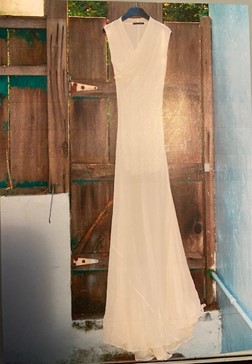
Back in Montreal, my wedding date still undetermined as we waited for papers to come through, I had second thoughts about the Lauren dress. It was pretty, but it was boring, and Lauren is the most conventional of designers. I wanted something unique — that would reflect the fashion maven I imagined myself to be. One blustery February day my best friend and I ventured out to visit Madame Balla at her rue Sherbrooke boutique Les Createurs. It was here that I truly fell in love: ivory silk georgette, the dress was sleeveless, with a gathered v-neckline and cut on the bias. It was very long, and, with only an inner slip hitting the upper thigh, it was diaphanous. Strangely it resembled my confirmation dress, although far less chaste.
The minimalist gown looked like it was designed by the lovechild of Madeleine Vionnet (1876-1975), widely hailed as an architect among dressmakers, and the Antwerp Six’s deconstructionists. The designer was practically a child – born in Brussels in 1977, Olivier Theyskens was gaining notoriety with his eponymous collection. He was the darling of the music industry, dressing Hole bassist Melissa auf der Maur (another Montrealer), and Madonna.
I bought the dress and put it away carefully in a garment bag.
When I moved to the States to get married, I returned the Lauren gown. But since we celebrated our marriage in a lowkey afternoon civil ceremony, I didn’t wear my Theyskens gown either – I wore a simple black pleated organza BCBG cocktail dress, with a black see-through Japanese happi coat I had picked up in Tokyo.
The Theyskens dress remained in its bag until years later when I was volunteering in the American Art Study Center in San Francisco’s de Young Museum. One Sunday, I read an article in the San Francisco Chronicle about the costume collection at the museum. The curator, Jill d’Alessandro, was dreaming aloud about her wish list for the collection. It included Belgian designers. The next day I called her and mentioned that I volunteered there and that I might have a dress for her.
The dress was accepted into the museum’s permanent collection. Jill was ecstatic: she had wanted a goddess dress and something from a Belgian designer and now she had both in one dress. I was thrilled to be able to donate my gown – now considered a work of art – to an institution I respect. I must concede my vanity: the gown’s acceptance established, in my mind at least, my status as a tastemaker. And even though the dress will never be worn, it will be preserved for posterity and may even be exhibited.
Update: December 2023. The current curator-in-charge of costume at FAMSF, Laura Camerlengo, is hoping to include the gown in an exhibition of wedding dresses, even though my dress was RTW Spring 2000 and not necessarily meant to be a wedding gown.
 BAALM
BAALM 