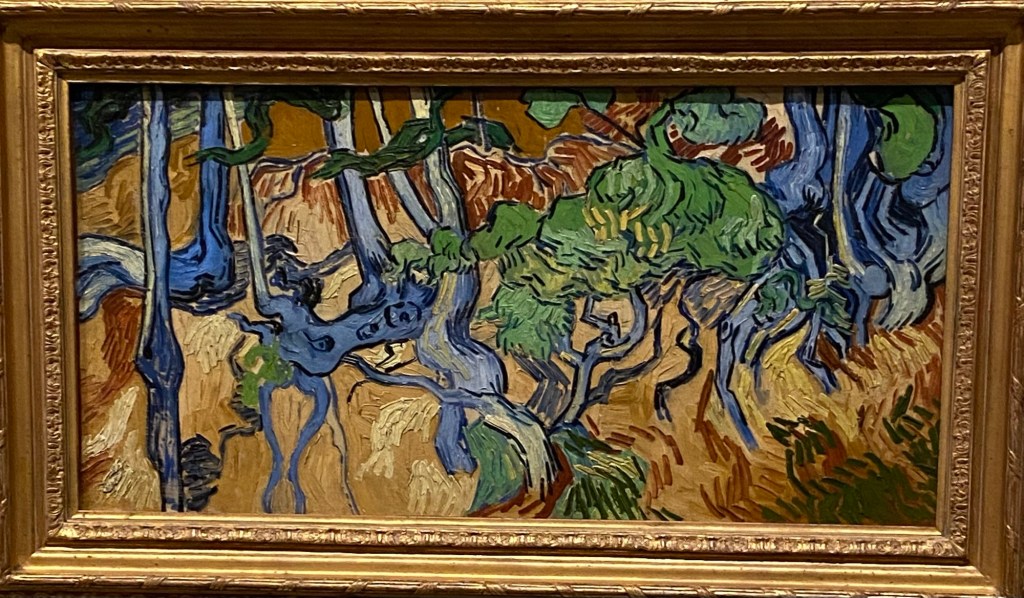
May 26, 2023 11:40 a.m. Van Gogh Museum, Amsterdam
I have just walked through an exhibition curated to celebrate the 50th anniversary of the Van Gogh Museum. A joint effort of the Museum and the Musée d’Orsay in Paris, Van Gogh in Auvers-sur-Oise, (located 18 miles outside of Paris), highlights the work created by Vincent van Gogh (1853-1890) in the final two months of his life. He painted no fewer than 74 canvases and drew over fifty drawings in this incredibly productive and fertile period. But as I stand in front of the last painting in the exhibit, painted on Sunday, July 27, 1890, I am moved by the simplicity of its subject, the thick impasto characteristic of his painting method, his use of his fingers in applying paint to canvas, the gnarly thick knots of the roots, and his use of colors – ochre and cadmium, Prussian blue, emerald green — which mimic no roots I’ve ever seen. This is his last work: just hours after finishing this canvas, the 37-year-old artist fatally shot himself, dying two days later.
As I gaze at this painting, I can discern no overt clues to his pain. But rootedness and tree roots were motifs in his work. He wrote to his brother Theo earlier that July, “my life, too, is attacked by the very root.” (Letter 898 to Theo and Jo, 10 July 1890). Senior Curator Emmanuel Coquery wrote that in Auvers, “painting became a feverish and desperate attempt to put down roots in the present … it is therefore very significant that Van Gogh’s last painting … depicts tree roots.” He concluded that, “For the painter, the root is vital point, the connection with life.” (Exhibition catalog, p. 158). The expression and movement in the painting indicate to me someone very much alive.
After I returned home to San Francisco, a clip from British sci-fi cult classic Doctor Who appeared in my Facebook feed. In the extremely poignant scene, Doctor Who and Ms. Pond take their time machine back and meet Van Gogh, played with heartfelt sensitivity by Scottish actor Tony Curran. They bring him to 2010 to the Musée d’Orsay. As he walks through the galleries, he admires impressionistic art, and then, he is led to a gallery hung only with his work. At Doctor Who’s prompting, Van Gogh overhears art historian Dr. Black, played by the always brilliant Bill Nighy, as he expounds upon what Van Gogh means to the history of art, and his character as a person. Van Gogh is moved to tears of gratitude. When Van Gogh returns to the late 19th century, he is energized and cannot wait to paint. While it would be naïve to think that Van Gogh would have had a longer, creative, and fulfilling life had he known recognition within his lifetime, (depression doesn’t work that way), it does make me wonder if he would have found some happiness in success – if he would have reached even greater heights.
While Tree Roots is not my favorite painting of van Gogh’s, it is the one I remember the best, the one that I see when I close my eyes. I remember it because it is his last painting, and I find that very moving. He died a pauper but what incredible riches he left us.
 BAALM
BAALM 